Saturday, August 13, 2011

Feelings about the Class

1.     What were you expectations for this course and where they met?
My expectations were met above and beyond. As I discussed in the extra credit evaluation I had a hard time managing everything on my plate but I felt the actual class was very rewarding. I’m a sensitive soul that loves to appreciate things and you gave us several opportunities that opened my eyes to amazing artists, paintings, sculptures, and styles. I enjoyed exploring the world of art. I wrote in my first blog entry that I expected to learn about the history of art and boy did I take in a lot more than that!
2.     Now that you've been through this course, What is art? How would you define it now compared to your intial posting?
Art is using imagination to create or convey ideas and concepts. It’s creativity and having a vision that you wish to express whether it’s conventional or not.
3.     Who was your favorite artist in your original posting and who is your favorite visual artist now? If there is a difference, why do you think so? If you have the same favorite artist, why do you think so?
My favorite artists have always been those that I’m most familiar with such as Van Gogh but now my favorite artist is Seurat. I’m blow away by Pointallism. I think it’s mind boggling… The time, the effort, and the precision that goes into the placement of each dot it truly remarkable.
4.     Now that you've completed this course, how do you feel about taking an online course? Is your answer the same as it was in your first posting? How is it the same or different?
I enjoy online courses but sometimes it’s nice to have interaction with the classroom especially when asking for suggestions and getting to know both the teacher and the classmates on a more personal level. My answer is the same. I think online courses help when physically going into the classroom each day is not exactly an option.

Portrait Time!!

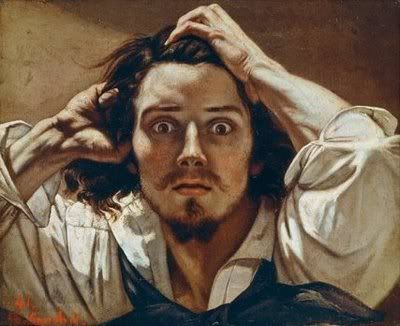
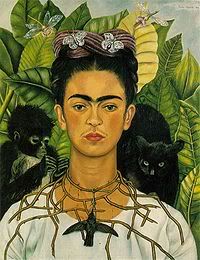
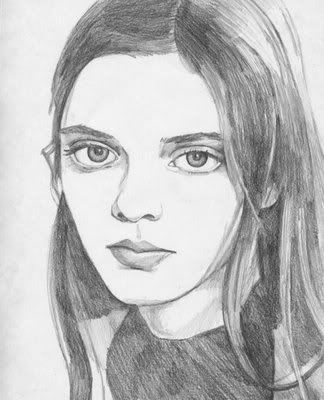
I selected the Frida as an inspirational piece because she’s so well known especially for self portraits. I chose the second female as an example because I knew I was going to draw myself and Tyelna’s portrait seemed more on the order of a raw portrayal that I hoped to convey. The third portrait was of a man Gustave Courbet and it was so detailed and realistic I felt captured by it. His expression and placement of his hands added to its appeal.
I chose to use pencil because I was hoping to add shadows to my cheeks and around my nose. I also planned on having multiple errors and from my experience trying to draw people in the past; I felt it was the best media for this project.
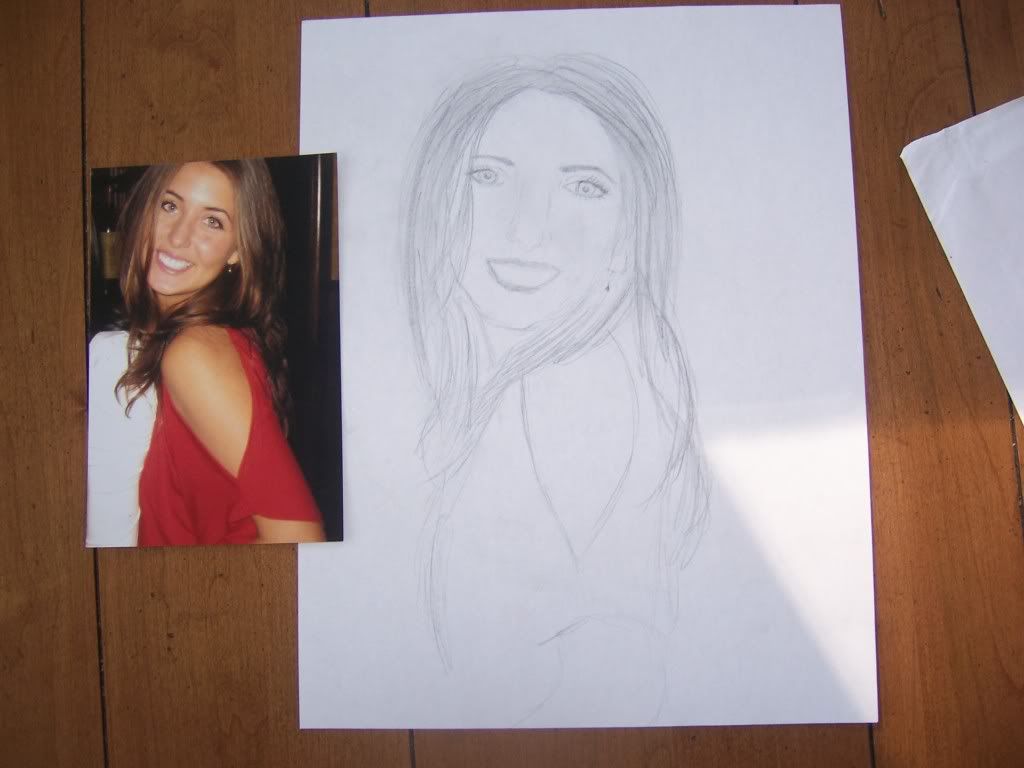
I had a really hard time because in my photograph my head is slightly tilted and when I couldn’t seem to place my facial features in a precise manner. I must have drawn my eyes fifteen times over and my nose even more. I drew teeth but the lead was so hard looking that it appeared as if I had braces on. I liked my drawing before I added a face haha.
This piece represents me to the best of my ability. The photograph I selected is my mom’s favorite current picture of me and I wanted to see if I could re-create it.
The elements of art I applied were the grey scale, balance, shape, symmetry and asymmetry.
I did enjoy this project. I don’t think I did as good as I had hoped I would but my mom is going to sit down with me the next time I’m home and help me out with drawing faces.
I selected the Frida as an inspirational piece because she’s so well known especially for self portraits. I chose the second female as an example because I knew I was going to draw myself and Tyelna’s portrait seemed more on the order of a raw portrayal that I hoped to convey. The third portrait was of a man Gustave Courbet and it was so detailed and realistic I felt captured by it. His expression and placement of his hands added to its appeal.
I chose to use pencil because I was hoping to add shadows to my cheeks and around my nose. I also planned on having multiple errors and from my experience trying to draw people in the past; I felt it was the best media for this project.
I had a really hard time because in my photograph my head is slightly tilted and when I couldn’t seem to place my facial features in a precise manner. I must have drawn my eyes fifteen times over and my nose even more. I drew teeth but the lead was so hard looking that it appeared as if I had braces on. I liked my drawing before I added a face haha.
This piece represents me to the best of my ability. The photograph I selected is my mom’s favorite current picture of me and I wanted to see if I could re-create it.
The elements of art I applied were the grey scale, balance, shape, symmetry and asymmetry.
I did enjoy this project. I don’t think I did as good as I had hoped I would but my mom is going to sit down with me the next time I’m home and help me out with drawing faces.
I selected the Frida as an inspirational piece because she’s so well known especially for self portraits. I chose the second female as an example because I knew I was going to draw myself and Tyelna’s portrait seemed more on the order of a raw portrayal that I hoped to convey. The third portrait was of a man Gustave Courbet and it was so detailed and realistic I felt captured by it. His expression and placement of his hands added to its appeal.
I chose to use pencil because I was hoping to add shadows to my cheeks and around my nose. I also planned on having multiple errors and from my experience trying to draw people in the past; I felt it was the best media for this project.
I had a really hard time because in my photograph my head is slightly tilted and when I couldn’t seem to place my facial features in a precise manner. I must have drawn my eyes fifteen times over and my nose even more. I drew teeth but the lead was so hard looking that it appeared as if I had braces on. I liked my drawing before I added a face haha.
This piece represents me to the best of my ability. The photograph I selected is my mom’s favorite current picture of me and I wanted to see if I could re-create it.
The elements of art I applied were the grey scale, balance, shape, symmetry and asymmetry.
I did enjoy this project. I don’t think I did as good as I had hoped I would but my mom is going to sit down with me the next time I’m home and help me out with drawing faces.
http://i1140.photobucket.com/albums/n563/marchetti7588/265.jpg
http://i1140.photobucket.com/albums/n563/marchetti7588/jess.jpg
http://i1140.photobucket.com/albums/n563/marchetti7588/jess3.jpg
http://i1140.photobucket.com/albums/n563/marchetti7588/jess2.jpg

Wednesday, August 10, 2011

What a Critical Assignment!


An Introduction to the Italian Renaissance (Giorgio Vasari)

  1. Vasari wrote, “Lives of the Artist’s”, and it acted as a culmination of famous artists and their work throughout the years.
  2. This allowed new artists to learn from artists that had already mastered many different styles of art.
  3. Barbarians destroyed a lot of artwork, which made it even more necessary to document paintings and sculptures from there on out.
  4. Perspective makes more distant objects seem farther away.
  5. Giotto used landscaping and architecture to add depth to paintings.
  6. Older works also influenced Giberti. He was able to reproduce the human figure very accurately.
  7. “David”, done by Donatello: “David’s” stance in the sculpture is called, “Contrapposto” due to its natural postioning.
  8. Da Vinci added science and math into the mix when creating art. He needed to see things from the inside out in order to recreate them. The human form needed to appear naturally in the surroundings.
  9. Raffaello made sure his painting were never too crowds or lopsided. He created balance.
  10. Michaelangelo taught himself at fourteen how to paint and sculpt by studying the work of others.

The Colonial Encounter: Views of Non-Western Art and Culture

1.      The largest fair was in 1900 in Paris. They celebrated friendship.
2.      The Dahome exhibit consisted of mud structures to enforce African culture.
3.      Violence eventually broke out civilizations became fearful. The barbaric people were banned from Europe.
4.      Dahome’s independence was shown through the portrayal of sharks. It represented determination to protect the water surrounding their land.
5.      By the 1900s tourism was on its way to become a major industry, which then led to building hotels to support travelers.
6.      Suddenly the exploitation of African men and women began taking place. They would display measurement of private parts and had them caged up as if it were an exhibit.
7.      The French took action and helped to prevent or at least minimize such pornography from taking place.

The Critics: Stories from the Inside Pages

            1. Good critics give you another way of looking at things.
            2. Steven Hunter believes that through writing we are able to evoke the imagination of others.
            3. The main function of critics is to help the consumers get the most out of the money that they spend.
            4. Because of critics the authors, directors, artists, actors have to keep on their toes knowing that they are being rated in the media for millions to see.
            5. The more credit critics receive, the greater their credentials, and the more we’ll    listen.
            6. Book critics are the most influential in their ability to help out new writers.
8.      Theirs an academic perspective to critics.
9.      Sometimes critics are called on to interview artists and they become that of a reporter too.
10.   This can breed subjective criticism.
11.  There is no real way to place accuracy on just one opinion but when others share similar views or when a critic becomes popular, people almost rely on their opinion when deciding whether to see/read something or not.


The videos definitely help in a couple of ways. Criticism, although it made be criticism, it should be constructive. How someone determines what is constructive is where it may become controversial but people that get into the business of entertaining others have to get used to scrutiny. Not everyone is going to like, understand, or appreciate everything they do. Feedback is a huge part of finding out what viewers want and what others are doing that is or isn’t successful.  Obviously critiquing our classmates is on a much different level but if someone asked me to critique their sketches that they were going to submit forward somewhere I would take that into greater consideration.

I thought the films were good. The most entertaining to me was the Renaissance one and the “Stories from Inside Pages”. I actually tried to watch the interviews with Greenberg but could barely hear him with both my volume and the websites volume up and everything else in the room off. It was almost impossible to hear anything. The Colonial Encounter was okay but I didn’t get nearly as much from it then I did the other two.

Sunday, August 7, 2011

Flower Power

This project opened my eyes to how one subject such as, flowers, can be depicted in such a wide variety of ways. I found Artstor to easy to use once I was able to actually create an account. It acted as an excellent tool to search and learn about various artists and their work. I chose to create a slideshow about flowers because I love nature, colors, and the beauty of flowers in particular. The only thing that disappoints me about a flower is that it’s not forever, so what better than to capture the essence of it through art. I feel like all of our assignment have been designed to help us act as a curator, to be able to look at art and see it on multiple levels. It was nice to be able to pick a subject line on our own although I really did enjoy you choosing categories for us to work with because it almost forced me to look further into styles and people that I would not normally have.

Wednesday, August 3, 2011

Video Reviews

The Lowdown on Lowbrow: West Coast Pop Art
  1. The actual definition to “Lowbrow” relates to someone with no “taste”.
  2. Lowbrow has been said to relate to pornography because of the “balls” they have to create such outlandish artworks that in some instances include nudity.
  3. It’s really a matter of taking art to the unknown and to have the audacity to take it to limits that are going to be controversial.
  4. Different forms of art that are said to be Lowbrow are: Conceptualism, Minimalism, Abstract, Expressionism and Pop Art.
  5. Lowbrow can be linked to music because of artists’ style, which can visually be reflected on album covers.
  6. Artist’s realized no one was going to stop them and that they were free to express themselves through art how ever they may like.

Displaying Modern Art: The Tate Approach
  1. This is the most popular museum in the world of modern art.
  2. There’s no admission and due to the oversize crowds visiting the museum on a regular basis they had to expand.
  3. The layout of the museum takes you through different styles of art and how they chronologically came to be.
  4. “Water Lillie’s” by Monet was said to be the most controversial piece in the whole museum because of traditional use of materials.
  5. There’s a room in the museum that doesn’t quite “flow” with the rest of the facility and because of its church-like atmosphere, not everyone is fond of the transition.

Bones of Contention:  Native American Archaeology
  1. There’s been much controversy about the remaining bones of the deceased.
  2. Some feel the bones should be “returned” to their ancestors versus being used for study.
  3. Archaeologists have even been criminally charged because of bone possession.
  4. This led to the creation of laws to protect Native American reservations.
  5. Eventually people were actually hired to protect gravesites.

George Eastman House: Picture Perfect
  
1.      Eastman was a marketing and business genius and was the founder of Eastman Kodak.
2.      He also created the first motion picture.
3.      Invented the first affordable camera.
4.      There’s a House that includes over 14,000 photographs for people to visit and take in.
5.      He even created a school that taught how to restore and preserve motion pictures.


Yes, they do relate to my project.  Although I haven’t started, it had given me ideas that are shifting the focus of where my project is going.

The first video relating to pop-art was presented in a manor that I can appreciate.  I’ll most likely star my project in an expressionist manor.  Generally I like the films I watched.  However, the film on American Indian film was more like history lesson rather than an expose on art in America.

Friday, July 29, 2011

Moore & Rothko

I chose the video on Henry Moore because I didn’t know much about him and Pop Art and Photography are forms of art that don’t catch my interest as much as sculpting and painting does.

Henry Moore

  1. 20th century artist exploring the human figure.
  2. One of seven children in a tiny house.
  3. He had a coal mining back round but was expected to become a teacher due to a couple of his siblings taking that profession.
  4. He had an obsession with the idea of mother and child. So much that he could turn just about anything into a figure resembling a mother with her child.
  5. The reclining figure is a theme of Moore’s sculptures.
  6. He proposed the idea that sculptures should have meaning to the architecture that surrounds it.
  7. Moore used his family upbringing to bring life and meaning to his artwork.
  8. He felt form captured more than facial expressions and experimented with proportions throughout his work.
  9. His drawings required him to pay more attention to detail and that is when he decided to separate both sculpting and drawing into two completely different categories.

This video was great. I enjoy watching biographies of artist’s, especially those that aren’t so familiar to me because I’d much rather see new artwork rather than to see a popular piece such as, “Starry Night”. Don’t get me wrong, I don’t mean “Starry Night” isn’t a masterpiece, but it’s nice to have you open the door for us to so many other artists.

Videos such as this always remind me of the pages in the book that give us a “sneak peak” into the lives of artists. I really enjoy his style. It reminds me of a specific set of collector items that Hallmark sells that are made out of wood. There’s a soft, flowy way about his style.


The Power of Art: Rothko

I chose this video for the exact same reason I chose to watch, “Henry Moore.” I wanted to know more about an artist I was not very familiar with.

  1. 9 paintings of Rothko were delivered to the Tate Gallery in London the same day he killed himself.
  2. He was born in Russia and it was during an era that “beating up on the Jews” was a familiar hobby.
  3. To “make ends meet” he even taught kids at a Jewish Community Center.
  4. Rothko began experimenting with Expressionism. This included thick dark lines.
  5. The “Subway Series” were his first set of paintings.
  6. He felt there was no psychological explanation for his work.
  7. Eventually he took a turn for the worst
  8. He had even created artwork for a restaurant that he hoped would be gruesome enough to make customers sick as they dined.
  9. He led a very dark life that was evidently shown in his work.
  10. His writings include a depressed cycle that sound as if he wished there were still no critics and that art could be done with out any backlash.


I think it’s interesting to hear how many artists live disturbing lives. His story just seems very similar to that of other artists and ironically Van Gogh’s, since I had just mentioned him in my previous discussion. It’s almost as if they were so lost in their own minds that painting was their only true way of expressing themselves. I remember when my grandmother passed away my mom began painting again after what was probably a twenty-year break. Her brush strokes were heavy and filled with anger and her color selection was dark and depressing. I guess you can’t really paint flowers and rainbows if you’re experiencing deep anguish. It’s a lot easier than I thought to get “into” the mind of an artist. At least to understand what feelings they are trying to express. I feel like the book and these videos have provided us such an intense understanding of what to observer when looking at art and how to break down the different elements used.

An Artist's Point of View

A Sunday on La Grande Jatte, 1884.

I chose this video simply because it is one of my favorite paintings. I think the style is mind-blowing because I can’t imagine the patience require to use pointillism to create an image much less than one of its size.

Georges Seurat is the artist of this painting.
  1. It began as an experiment and wound up an obsession.
  2. To this day, no one is positive what it is about. The people don’t make sense nor do the proportions.
  3. There’s forty eight total people in the painting.
  4. There’s a monkey on a leash that is questionable. Some suggest that it could mean the term known as, “monkey business”.
  5. There’s only one photograph of the artist, Seurat. He was known for being a very strange man.
  6. Pointillism is the term given to the technique that Seurat used. More simply put, it is the use of individual dots to create a piece.
  7. He spent 6 months visiting the same island from the same vantage point to study the surroundings.
  8. He didn’t just use dots but also dashes and verticals and horizontals.

This video relates to several different chapters in the text. It covers style, technique, color, interpretation, and the mind of the artist.

I thought the film was excellent although I was a little disappointed to hear Georges Seurat wasn’t mentally all there. It makes sense though that a technique such as Pointillism would first begin as an experiment and then suddenly become an obsession. It seems like the type of work to take over ones life.


Dada and Surrealism

I chose this film because I wanted to know more about it. Prior to this chapter, I had not heard of the term “Dada”, although the category of work it covers seemed relatively familiar.

Schwitters
  1. He was known for making collages.
  2. He collected fragments of WWII to use in his creations.
  3. The use of old items opened up art on a new level.
  4. Often used the term, “Merz”, and even created a magazine called that.
  5. In 1933 he was forced to leave Germany by the Nazi’s but this helped to mold his persona.
Hoch
  1. Dada meant, “yes, yes” in Russian.
  2. Hoch used Dada as a “weapon” to act out.
  3. She used political and business figures to revolt and to create characters mocking them.
  4. She was ruthless and spared no one “neither friend or foe”.

This movie wasn’t as exciting as the first one. I was hoping to see several different examples of work rather than just two. It didn’t provide me with any additional knowledge of Dada and Surrealism than the book already had explained. It could also be because I don’t think I care for this style too much. I feel like the work created is so negative and is done strictly to destroy the reputation of others. It’s definitely personal preference.